How to Shut Off Water in Your NYC Apartment During a Plumbing Emergency
A burst pipe, an overflowing toilet, or a failed supply line can dump gallons of water into your apartment within minutes. In a dense New York City building, that water does not just affect you. It travels through ceilings and walls and into the units below you.
Knowing how to shut off your water supply quickly is one of the most practical skills any NYC renter or property owner can have. Here is what you need to know before an emergency happens.
Why NYC Apartments Present Unique Plumbing Challenges
Hamilton Heights and the broader Upper Manhattan area are home to a mix of prewar buildings, converted brownstones, and mid-century co-ops. Many of these buildings have aging plumbing systems with older shutoff valves that have not been turned in years.
- Cold winters increase the risk of frozen and burst pipes, especially in exterior walls and unheated spaces
- Older buildings often have galvanized steel or cast iron pipes that corrode from the inside over time
- High water pressure, common in NYC high-rises, puts extra stress on supply lines and valve connections
- Shared risers mean a problem in one unit can affect multiple floors quickly
Knowing your shutoff locations in advance gives you a head start when every minute counts.
Locate Your Shutoff Valves Before You Need Them
Do not wait for a flood to start searching. Walk through your apartment now and find these key locations.
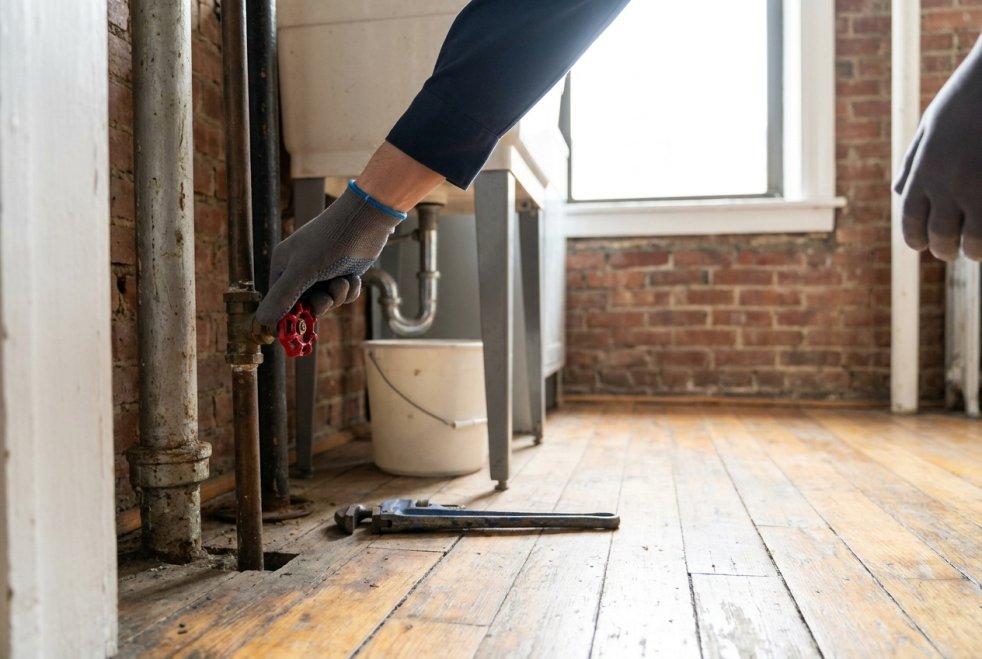
Under sinks: Every kitchen and bathroom sink has a pair of shutoff valves on the supply lines beneath the cabinet. One controls hot water, one controls cold. Turn them clockwise to close.
Behind the toilet: Look for a small oval or football-shaped valve on the wall near the base of the toilet. Turning it clockwise stops water from flowing into the tank.
Behind the washing machine: If your unit has an in-unit washer, there are hot and cold supply valves on the wall behind or beside the machine.
Under the water heater: If you have a dedicated water heater, there is a cold supply valve on the inlet pipe at the top or side of the unit.
How to Find and Use the Main Apartment Shutoff
If a pipe bursts and you cannot isolate the source, you need the main shutoff for your unit. This is the single valve that cuts all water supply to your apartment.
- In most NYC apartments, the main shutoff is located near the front door, inside a utility closet, or behind an access panel in the kitchen or bathroom
- In older buildings, it may be a gate valve (a round wheel-style handle) rather than a lever. Gate valves require multiple full clockwise turns to close completely
- If the valve is stiff or corroded, use a wrench carefully. Do not force it, or you risk breaking the valve stem
- If you cannot find your unit's shutoff, call your building super immediately
Once you locate it, test it once a year to make sure it actually moves. A valve that has not been turned in a decade may be seized when you need it most.
When to Go Straight to the Building Main Shutoff
Some emergencies are too large for a unit-level valve to handle. If water is gushing from a shared riser, a main supply line, or a pipe inside a wall, the building main shutoff is the right call.
- Contact your building superintendent or the superintendent's emergency line immediately
- In a co-op or condo, there is typically a main shutoff in the basement or mechanical room
- Do not attempt to access the building's main entrance yourself unless you are the property owner and know where it is
- If the super is unreachable and water is spreading rapidly, call 311 or the NYC Department of Buildings emergency line
Document the damage with photos as soon as it is safe to do so. This protects you with your landlord and your insurance carrier.
What to Do After the Water Is Off
Stopping the flow is step one. What you do next determines how much damage you end up with.
- Move rugs, furniture, and electronics away from wet areas immediately
- Place towels or buckets to contain standing water and slow the spread
- Do not use electrical switches or outlets near any wet surfaces
- Open windows if the weather permits to begin drying the space
- Notify your landlord or building management in writing, even if you have already called them
Mold can begin developing within 24 to 48 hours in a damp environment. Getting a plumber on-site quickly reduces the risk of secondary damage.
Warning Signs That a Plumbing Emergency Is Coming
Most plumbing emergencies give some warning before they become a crisis. Watch for these signs in your NYC apartment.
- Discolored or rust-tinged water coming from faucets
- A sudden drop in water pressure at one or more fixtures
- Damp spots or bubbling paint on walls or ceilings
- A musty smell near cabinets or along baseboards
- Hissing or banging sounds inside the walls when water is running
Any of these signs in a Hamilton Heights building, especially one built before the 1970s, deserves a professional inspection before the problem escalates.
Call a Licensed Plumber Right Away
Shutting off the water stops the immediate damage. But the underlying problem still needs to be diagnosed and repaired by a licensed professional. Attempting to reconnect supply lines or patch pipes without the right experience often leads to a second failure.
Glenn's Plumbing Services serves homeowners, renters, and property managers throughout Hamilton Heights and the surrounding Upper Manhattan neighborhoods. Our team knows the plumbing systems common in this area, from prewar cast iron to modern PVC, and we respond quickly when emergencies happen.
Call (929) 657-0643 to schedule service or get help with a plumbing emergency. The sooner you call, the more we can do to protect your home.

-Logo.wine.svg)


